
Gemba Growth Model: determine the next step in your asset management
You want to take steps with your asset management. But where do you stand now? And what should you tackle first? The Gemba Growth Model maps the maturity of your asset management and forms the basis for a roadmap with concrete improvement steps. You not only see your starting position, but also which preconditions you need to have in place to grow in a targeted way.
 More data does not yet mean better asset management
You have more information about your assets than ever before. Alongside work orders, failure history and asset information, you increasingly use sensor data and OT signals. Systems such as IBM Maximo Application Suite (IBM MAS) also offer extensive capabilities for reliability centred maintenance, asset lifecycle management, asset health and predictive analytics.
But more data and more functionality do not automatically lead to better asset management. If processes are unclear, roles are not fixed or data is unreliable, the main result is more noise.
A dashboard for maintenance KPIs can look sleek, for example. But if work orders are not closed consistently or asset data is incomplete, you are still steering on the wrong information. The same applies to predictive maintenance. If you want to predict failures, you first need to know which assets are critical, how they can fail and what impact downtime has.

Gemba Growth Model shows the coherence
To improve your asset management, you therefore do not only look at tooling. You also assess whether goals, processes, roles, maintenance strategies and data are sufficiently aligned.
That is how we work at Gemba with our clients, and we have now captured this approach in our growth model. The model brings all information about the current state of your asset management together in one structure. Not a loose collection of findings from conversations, analyses and systems, but one dashboard that shows the coherence between your goals, set-up, data and way of steering.
Asset goals as the starting point
The starting point is your asset goals. Do you want to increase the availability of a production line? Reduce safety risks? Demonstrate compliance more effectively? Or better substantiate replacement investments? Those goals determine which improvements add value.
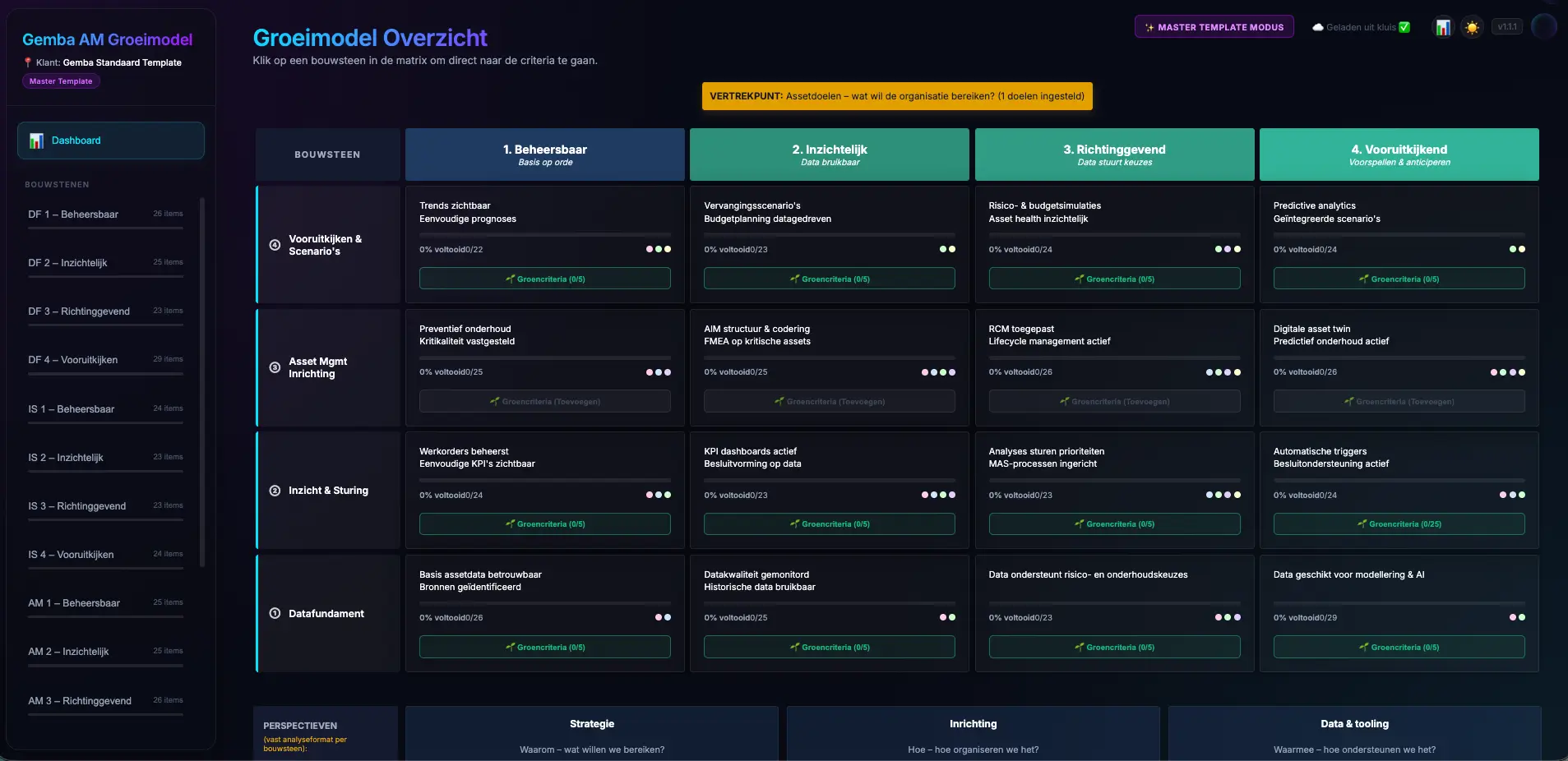
You then assess four building blocks:
Data foundation: are asset data, maintenance history and data sources reliable and usable?
Insight and control: can you track KPIs, recognise deviations and steer in a targeted way?
Asset management set-up: are criticality, maintenance strategies and lifecycle choices properly organised?
Looking ahead and scenarios: can you predict and calculate risks, maintenance needs and investment choices?
For each building block the model shows how far your organisation has come. Is the foundation in order? Are you using data actively? Are you already steering choices on risk and impact? Or can you look ahead and compare scenarios? The result is not only a maturity score. You also see which step logically follows and which conditions you need to meet first.
Asset goals translated into measurable criteria
Under each building block and growth phase lie concrete questions and measurable criteria. Think of asset types in scope, mandatory basic fields per asset type, linked data sources, failure modes, work order quality and agreements on data quality.
This keeps the growth model practical. You do not only discuss whether your organisation works in a data-driven way, but check what needs to be demonstrably in place for that.
Suppose you want to increase the availability of a critical production line. You then translate that goal into concrete conditions. Are the critical assets clearly defined? Is it known which failure modes occur? Are work orders closed fully and consistently? And is the maintenance history reliable enough to recognise patterns?
From ambition to a concrete roadmap
The central dashboard of the Gemba Growth Model shows at a glance which parts of your asset management are in good shape, where the gaps are and where most attention is needed. What is green, what is amber and what is still red? From this overview you click through to the underlying questions, criteria and growth conditions.
The dependencies between improvement steps also become clear. Perhaps you want to revise the maintenance strategy for all assets at once, but the analysis shows that the asset structure of one critical production line is still incomplete. Then you start there, before rolling out the approach more widely.
In a roadmap you then translate the outcomes of the growth model into actions, in an order that fits the ambition and the current maturity of your organisation’s asset management. That is also a step we help you with from Gemba; we are currently fully engaged with this at one of our clients.
(click to enlarge)
Not everything at once, but in the right order
The strength of the Gemba Growth Model is that you do not need to reach the same maturity level on every part. You can already work strategically on a better set-up of your asset management while your organisation strengthens the data foundation at the same time. You can also already determine which KPIs are needed while teams are still working on registration agreements and data quality.
As long as you take their interdependencies into account, different improvement actions can certainly run in parallel. You do not have to wait until everything is finished, but you do avoid skipping crucial steps.
For each building block you determine the ambition, the current level and the conditions for the next step. This creates a roadmap that fits your organisation and remains workable.

Would you like to know where your organisation stands and which step is logical towards predictable and data-driven asset management? Contact Stefan Hoffmanns on +31 (0)6 41 56 16 32 or s.hoffmanns@gemba.nl.
Look at all blogs

IBM MAS 9.2: new features for management, AI and Mobile
Discover what IBM MAS 9.2 adds for management, AI, Manage, Mobile and Spatial. From the MCP server to smarter user management and less custom development.
Would you like to discuss your asset management challenges?

Also curious about the possibilities?
Want to know more about the possibilities of IBM MAS? We are happy to think along with you about the practical application in your organization. Contact us via +31 (0)20 482 29 29 or info@gemba.nl.